


The National Federation of Teachers Unions (NFTU) yesterday mobilized tens of thousands of teachers nationwide to take part in a rally against what they said was a “disastrous pension reform plan” by President Ma Ying-jeou’s (馬英九) administration.
Several representatives from the Taiwan International Workers Association, the Labor Rights Association, the National Federation of Independent Trade Unions and the Taiwan Higher Education Union joined the rally, which took place between 3pm and 5pm on Ketagalan Boulevard in front of the President Office in Taipei.
Wearing head bands and signs that read: “Bring down the disastrous reform plan,” more than 30,000 teachers from different levels of education and from various parts of the nation jointly voiced their anger over the pension reform plan.
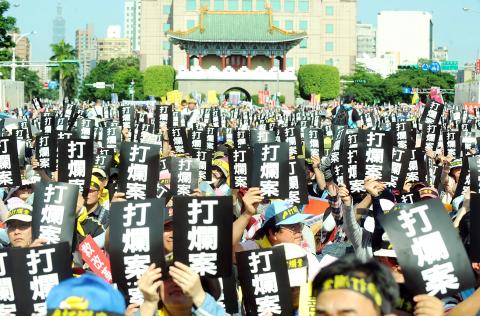
Photo: Wang Yi-sung, Taipei Times
“The Ma administration has turned a blind eye to the many flaws in its pension reform plan and turned a deaf ear to the heart-felt advice given by the NFTU and other workers’ unions. Its goal is not to improve the pension system, but to protect its own people from getting hurt in the process,” the NFTU said in a press release issued before the protest.
“The administration has managed to put forward a reform plan that runs counter to the theory of social insurance, violates the principle of intergenerational equity, excuses the government from its responsibility and is set to worsen social divisions,” the press release said.
NFTU director-general Liu Chin-hsu (劉欽旭) said that while the federation was in favor of pension reforms, the scheme proposed by the Ma administration was merely an unjust and “pseudo-reform” that favored high-ranking government officials.
“The pension reform policy has become nothing but a scam. It has sought to look after the interests of people in the higher echelons of the ruling class by sacrificing those of grassroots employees,” Liu said.
Saying that the reform plan was not the only government policy “bullying” educators, Liu said that the Cabinet’s draft amendment to the Teacher’s Act (教師法) could also leave teachers vulnerable.
“The amendment proposes bringing what it said are ‘disinterested social members’ into schools’ faculty evaluation committees, while slashing the number of seats on the committees for teachers. In the end, school principals and parents would be the ones having the ultimate power to decide the fate of teachers,” Liu said.
Among the protesters were Changhua Senior High School teacher Pai Hung-pin (白宏彬), 46, and his wife, National Changhua Girls’ Senior High School teacher Ku Hsiang-chin (谷湘琴).
“My wife and I chose to study at National Taiwan Normal University over National Taiwan University not only because we love teaching, but also because we thought the government would ensure the stability of our jobs and our well-being,” Pai said.
“Who would have thought that we would be here protesting against the Ma administration’s ridiculous pension reform plan two decades later?” Pai said.
National Hualien Girls’ Senior High School teacher Hung Lung-chiu (洪龍秋) said he had been devoted to teaching and put his faith in the Chinese Nationalist Party (KMT), only to be disappointed by the Ma administration’s political maneuvering under the guise of reforms.

The National Chungshan Institute of Science and Technology yesterday showcased its locally developed variants of the Vision 60 robotic patrol dog, which it plans to deploy on the nation’s outlying territories in the South China Sea. The variants were produced under the Joint Lab project — created by the institute and domestic companies — and assembled with domestically produced motors, lenses and artificial intelligence (AI) systems alongside licensed tech from the US, Missile and Rocket Systems Research Division deputy director Jen Kuo-kang (任國光) told the media event at a military base in Taipei’s Dazhi (大直) area. Taiwan has built up its strengths

RIGHT DIRECTION: Taiwan’s efforts to prevent forced labor include a proposal to ‘fully prohibit’ employers from withholding workers’ documents, an official said Taiwan is to establish a mechanism to restrict imports of goods linked to forced labor, the Executive Yuan said yesterday, after the US proposed imposing additional tariffs on Taiwanese goods over labor concerns. “The Ministry of Labor and the Ministry of Economic Affairs are to establish an interministerial review procedure,” Executive Yuan spokesperson Michelle Lee (李慧芝) said at a news briefing in Taipei. “The government is to use the Foreign Trade Act [貿易法] as the legal basis to restrict imports of goods produced with forced labor” and bring its supply chain governance more in line with international standards on human rights, resilience

NOT IMMEDIATE: Taiwan has a chance to appeal the proposed 10 percent tariff before it starts, while other countries face a 12.5 percent tariff from the trade office Taiwan is among 60 economies determined by the US to have failed to impose or enforce a ban on the importation of goods produced with forced labor, according to a notice released on Tuesday by the Office of the US Trade Representative (USTR), which proposed imposing an additional 10 percent or more tariff on them. The USTR in a statement said that following an investigation, it had determined under Section 301 of the Trade Act of 1974 that the failure of the 60 economies to impose and effectively enforce a prohibition on the importation of goods produced with forced labor is

TIT-FOR-TAT: The US allegedly revoked the visa of a Chinese national working at Xinhua News Agency in the US in response to Beijing’s expulsion of Vivian Wang The Presidential Office yesterday condemned China for expelling a New York Times correspondent from Beijing following the newspaper’s interview with President William Lai (賴清德), saying the move highlighted Beijing’s suppression of press freedom and its threat to international news media. Taiwan has noted a series of recent incidents in which Beijing used similar tactics to “threaten and pressure international media outlets and journalists,” Presidential Office spokeswoman Karen Kuo (郭雅慧) said in a statement. “This concerns not only press freedom and freedom of expression, but also the safety of journalists, and Taiwan and relevant partners are paying close attention to the situation,” she


 RSS
RSS